


 India / English
 APAC / English
 France / Français
 Latin America / Español
 Europe / English
 Africa / English
 US / English
Most people who ask this question, have an underlying question they really mean to ask: Can I use the same engine oil in my motorcycle and dirt bike?
Sure: you can use a single oil formulation for all your toys (assuming you use the correct viscosity in each). But you shouldn’t. Rather like saying you can pour Extra Virgin Olive Oil into your machines, but you shouldn’t.
Why? Because each type of engine gives unique challenges to engine oil that one single formulation can’t meet. Let’s look at the different types:
- V-Twin Motorcycle
- Metric Motorcycle
- Dirt Bike
But first, let’s look at what the engine oil must do regardless of the application.
Whether for a Harley-Davidson, Kawasaki sport bike, or dirt bike, the engine oil has to protect against wear and fight the damaging effects of extreme heat. These include deposit formation, which robs the engine of efficiency and power. It also includes “oxidation”, or chemical break down. The sooner the oil breaks down, the sooner it stops guarding against wear and deposits. And the sooner it requires changing, wasting time and money.
That’s simple enough. And years ago, it was possible to make one engine oil to protect all those applications. But today’s engines are not so simple.
V-Twin Motorcycle
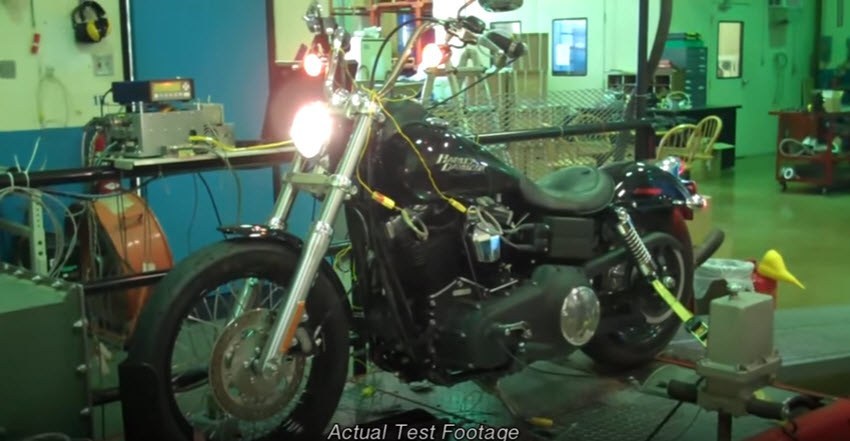
Let’s look at your classic air-cooled V-twin, like the engine found in most Harley-Davidson motorcycles. These engines get hot. How hot? In our mechanical lab tests, we saw cylinder temperatures reach 195ºC. In contrast, our liquid-cooled 2017 Indian Scout running the same test demonstrated cylinder temperatures on average of 93ºC.
That intense heat can wreak havoc on engine oil. The oil can lose viscosity and become thin, effectively turning your 20W-50 into a 10W-40, or worse. A lighter viscosity than what the engine is designed for can fail to protect parts against wear. Extreme heat also speeds up chemical break down.
In fact, the rate of oxidation doubles for every 10ºC increase in oil temperature. That means for every 10ºC increase in temperature, oil life is cut in half.
It’s vital that the oil meant for your air-cooled V-twin is formulated to withstand such intense heat. To accomplish that, we formulate AMSOIL Synthetic V-Twin Motorcycle Oil with added resistance to extreme heat. Its naturally heat-resistant synthetic base oils maintain viscosity despite the extreme heat and the shearing force of transmission gears “cutting” the oil’s molecular structure. That translates into reliable protection in the toughest riding conditions.

Metric Motorcycle
What about a metric sport bike? How different can it be from a V-twin?
In this case, foam is one of our biggest enemies. A metric bike can easily surpass 10,000 rpm. The mechanical action of the crankshaft spinning that fast can whip air into the oil, causing foam.
If the oil isn’t formulated with fast air-release properties, foam bubbles will travel throughout the engine. When they collapse between meshing gears or bearing surfaces, nothing is left behind to provide protection except air.
We all need air, but not for protecting high-performance engines against wear!
That’s why we formulate AMSOIL Synthetic Metric Motorcycle Oil specifically to resist foam. Its anti-foam additives weaken the surface tension of air bubbles, helping eliminate foam. This results in excellent wear protection no matter how heavy you push the throttle.
Dirt Bike
Finally, we have dirt bikes. The bike undergoes similar low-speed stress punctuated with periods of high revving.
In a race, you open the throttle coming out of the gate. Then you back off when you get to the first corner. You open up the throttle again through the whoops, causing the rear tire to spin freely when it’s in the air, but create a heavy load on the engine when it contacts the ground.
Where dirt bikes differ, however, is in engine design.
Dirt bike engines are typically lightweight designs meant for performance. Any time you remove mass, yet increase power, you increase engine stress. The combination of high rpm and lighter materials creates the perfect scenario for engine failure should the engine oil fail to do its job. Plus, dirt bike pistons tend to have shorter piston skirts to reduce friction. That may help your lap time, but it doesn’t help engine longevity. The shorter piston wants to rock inside the cylinder, which concentrates tremendous force on the tiny area where the piston skirt and cylinder wall contact. Only a microscopic oil film provides protection in this area, meaning the oil must offer the film strength needed to help the engine survive.
Check out the image to see what can happen. This piston cracked after more than 100 hours of use. Wear shrunk the piston and caused it to rock back and forth in the cylinder. The continual hammering action finally caused it to fail.
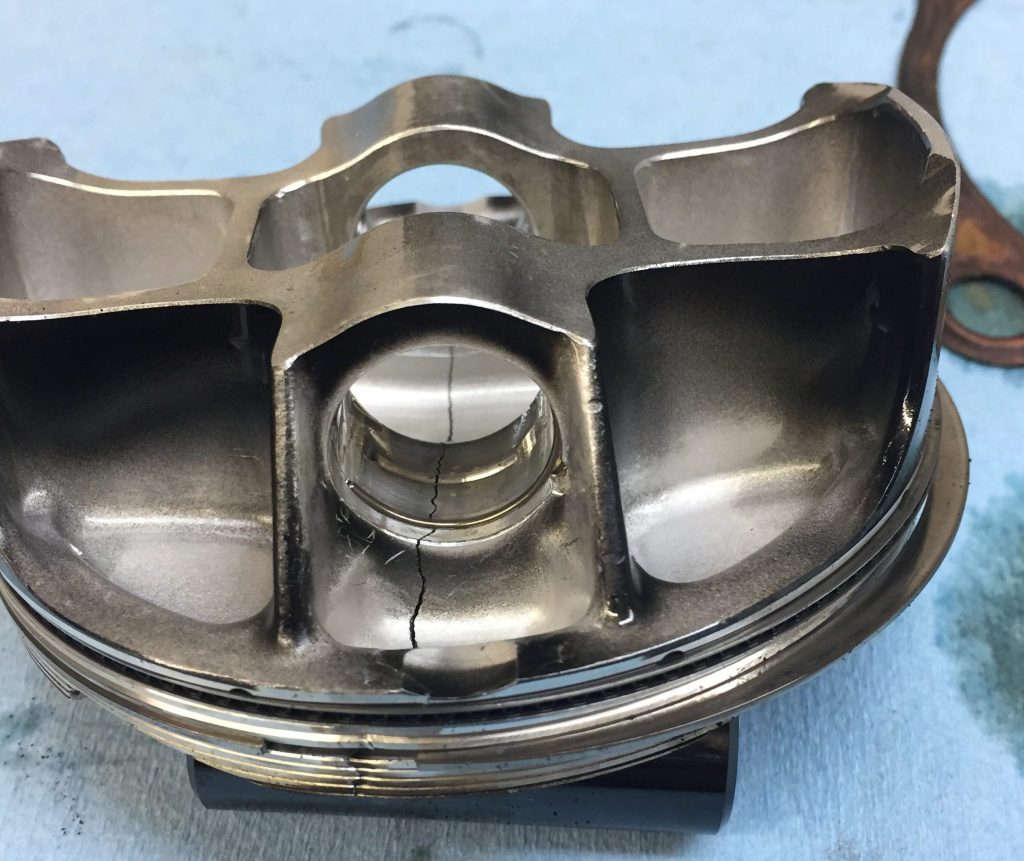
High stress combined with its lightweight design caused this dirt bike piston to fail.
Making matters worse, dirt bikes barely hold any oil. Roughly one quart is common. Think about everything that single quart of oil must do:
- Fight wear
- Resist heat
- Prevent deposits
That’s why most riders change engine oil frequently. Rebuilding the top-end every 15 hours or so is common.
But just because dirt bike oil is changed frequently, don’t think you can use cheap oil. It’s far less expensive and less work to pay a little more up front for a good oil than it is to rebuild your top-end.
The moral of the story is this: the days of using one engine oil for all your toys is over. Each application creates unique challenges that are best suited for a tailor-made engine oil formulation.